This article covers:
Hunger as a challenge for governing bodies
The history of soup kitchens (Cucine Popolari) in Bologna
The principles of Cucine Popolari
Feeding the people is an endless task, one that very few governing bodies manage to tackle, even though it should be the primary focus of society: no person without a roof, no child without education, no mouth unfed. Visiting Bologna, I approached the city with my characteristic scepticism, expecting a social system that is crumbling and understaffed. What I found was a pleasant surprise, a municipality actually run with its people in mind, aiming to make the city more green, more sustainable and above all, more livable. We talked to members of the Bologna City Council, visited several organizations tackling food poverty, and the more I saw the more I fell in love with this city and its open arms.
On the third day of the Clymact Event, we visited the Oldtown of Bologna, but for lunch, we took a bigger walk to the Navile District, where at Via di Battiferro we were treated to a three-course meal at this Cucina Popolare. Cucine Popolari are soup kitchens in four districts of Bologna, run entirely by volunteers. We had a chance to listen to one of the original founders of these kitchens, Roberto Morgantini, who opened the first Cucina Popolare at that very location in 2014. Since then, three other kitchens have been opened in three neighbourhoods, and the goal is to have one kitchen in each neighborhood of Bologna. These kitchens are run by volunteers and funded by donations, and are run with not just food, but community in mind. They didn’t want to just create “a food court for poor people”, they wanted to make it feel like a diner or a kitchen at home with proper ceramic plates, glasswear and cutlery. The guests’ dignity is just as much in focus as their apetite. Another priority is to not just fight hunger, but loneliness too. People are encouraged to talk to each other during lunch, and if the guests have the ability to do so, they are more than welcome to volunteer as well.
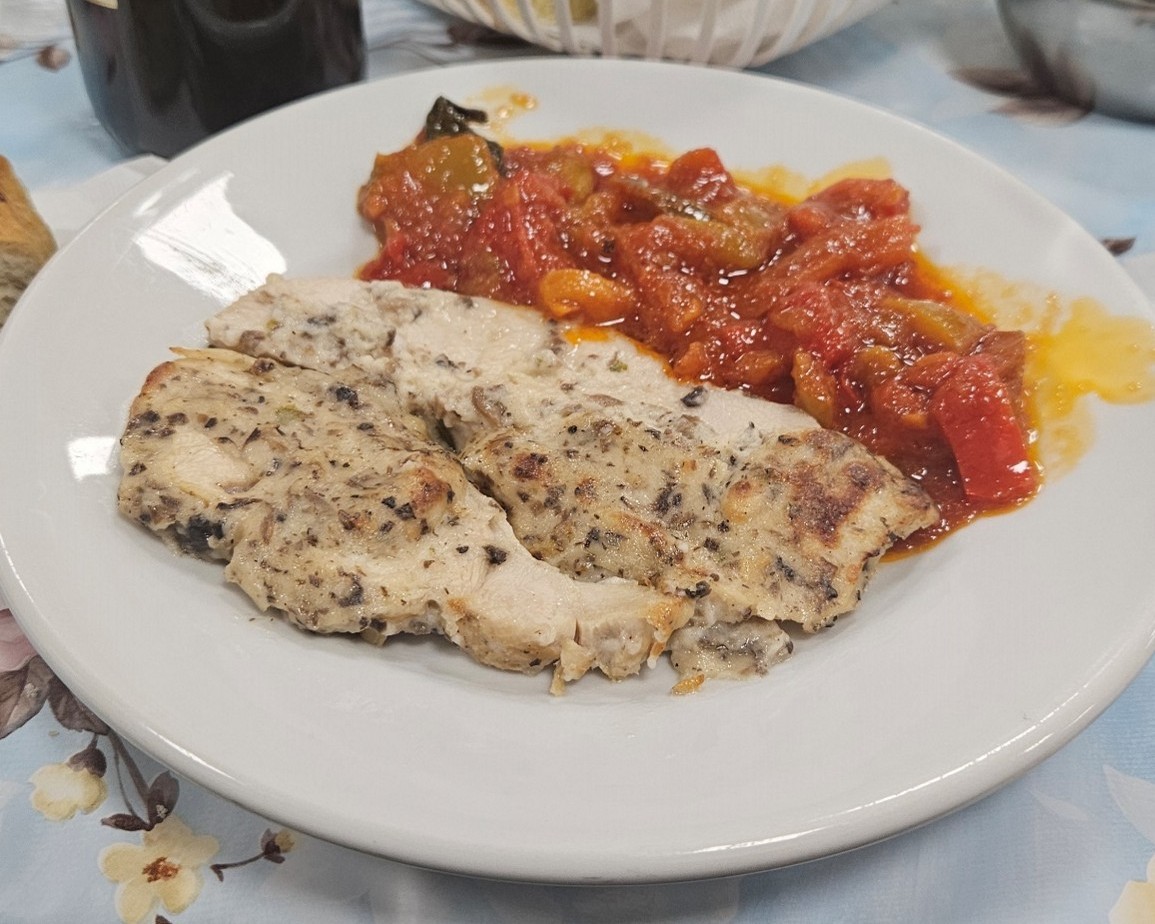
The food we were served was scrumptious, it might honestly have been the best food we had the whole week (though I might be biased). We were greeted with fresh bread on the tables and were offered traditional meatballs and a type of bread with pork in the dough (sadly I cannot recall the name). The first course was a beautiful mushroom lasagna with herbs in the pasta dough (which was quite filling already), and then we got to the main course which was a well seasoned chicken breast with some more mushrooms on it, with the side of a ratatuille-like vegetable stew. For dessert, we were given cornettos, though very few people had the stomach space for it at that point.
For people with dietary restrictions, for example people with allergies, vegetarians or muslim people who cannot eat pork, the kitchen serves other options. The food they serve is delicious, nutritious and homely. The dining area itself was warm and welcoming, and so were the volunteers.
The pandemic was a breaking point for a lot of people, both socially and financially, so it should come as no surprise (though it did surprise me) that with covid, the number of guests at these kitchens increased dramatically. During the covid pandemic, Cucine Popolari had to give up one of their main focuses – community – and switch to takeaway deliveries to protect both the guests and the volunteers working there. The number of guests doubled, with each kitchen serving 200-250 people daily pre-pandemic, and 500 people since then. While that is concerning, the number of volunteers also skyrocketed during those times, given that a lot of elderly and/or immunocompromised volunteers couldn’t help anymore, a lot of young people (mainly university students) joined in, meaning that there are currently approximately 2000 registered volunteers.
Of the few days I’ve spent in Bologna, I think the most magical place of all was this little kitchen, run by community and philanthropy. I wish places this like were more common all throughout Europe, where a hungry mouth isn’t just something to feed, but a human being to aid and listen to as well.

[1] Find your track. [2] Join our online info session. [3] Apply!
This track provides aspiring diplomats and those interested in international public servants with in-depth knowledge and practical skills essential for a successful career in international relations. Participants will engage in workshops on diplomatic protocol, cultural diplomacy, and science diplomacy, alongside visits to embassies and relevant international organisations. These activities offer hands-on experience and insights into diplomatic practices and international development, helping participants develop the necessary skills and network to excel within international organisations.
Aspiring diplomats – International relations enthusiasts interested in careers in diplomacy, international development, and global cooperation.
International public servants – Students and young professionals interested in pursuing a career at an international organisation like the United Nations, UNESCO, UNHCR, or UNICEF, for example, without necessarily wanting to be a diplomat (i.e. remaining independent of any single nation’s government). Interests may include advancing global peace, international development, and human rights.
[1] Find your track. [2] Join our online info session. [3] Apply!
This track equips aspiring public servants and NGO leaders with the skills and knowledge necessary for impactful community work. Participants will attend workshops on introduction to nonprofit management and civic engagement, effective altruism, social innovation, design thinking, community engagement, and fundraising. Additionally, visits to local NGOs and municipalities will provide practical insights into the functioning and challenges of civic organizations. This track aims to foster effective leadership and innovative thinking in addressing social issues.
(Aspiring) public servants – Students and young professionals who work, or aspire to work, in government departments or local municipalities in their country, and who seek to enhance their skills, network, effectiveness in public administration and ability to improve their communities.
(Aspiring) non-profit founders – Passionate individuals interested in creating and leading non-profit organisations focused on addressing social and environmental issues.
Young changemakers and community organisers – Young leaders dedicated to mobilising communities and fostering grassroots movements to drive social change. This includes environmental advocates committed to promoting sustainable practices and policies to combat environmental issues.
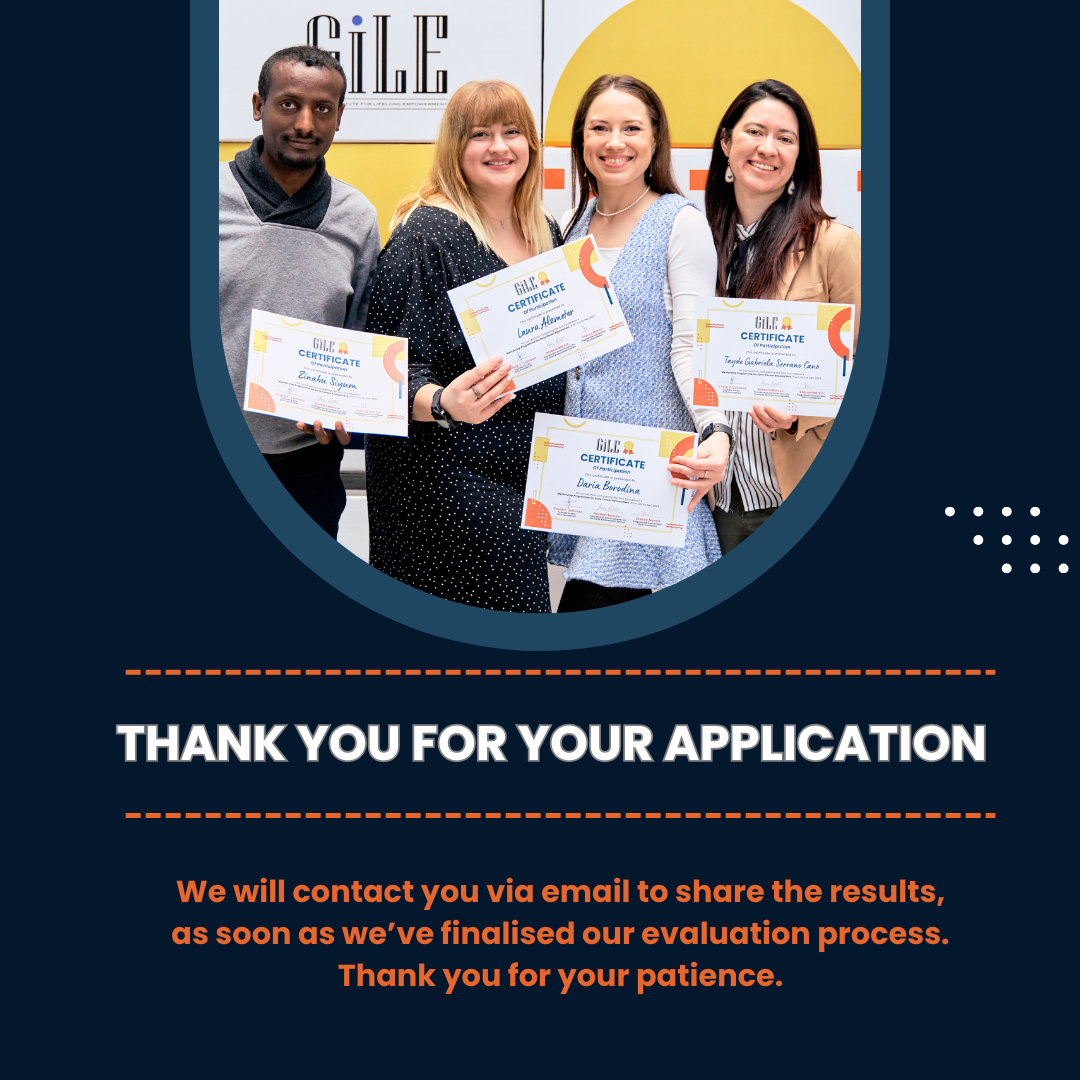
The following roles are currently available:
The role consists of:
Location: This role can be done in Budapest (Hungary) or remotely, from anywhere in the world.
Qualifications: No formal qualifications are required. However, the candidate should have previous demonstrable experience.
Skills and requirements:
The role consists of:
Location: This role can be done in Budapest (Hungary) or remotely, from anywhere in the world.
Qualifications: No formal qualifications are required. However, the candidate should have previous demonstrable experience.
Skills and requirements:
The role consists of:
Location: This role can be done in Budapest (Hungary) or remotely, from anywhere in the world.
Qualifications: No formal qualifications are required. However, the candidate should have previous demonstrable experience.
Skills and requirements:
The role consists of:
Location: This role can be done in Budapest (Hungary) or remotely, from anywhere in the world.
Qualifications: No formal qualifications are required. However, the candidate should have previous demonstrable experience.
Skills and requirements:
The following roles are currently available:
The role consists of:
Location: This role can be done in Budapest (Hungary) or remotely, from anywhere in the world.
Qualifications: No formal qualifications are required. However, the candidate should have previous demonstrable experience.
Skills and requirements:
The role consists of:
Location: This role can be done in Budapest (Hungary) or remotely, from anywhere in the world.
Qualifications: No formal qualifications are required. However, the candidate should have previous demonstrable experience.
Skills and requirements:
The following roles are currently available:
The role consists of:
Produce written or verbal content that is clear and persuasive for our target audience for various platforms in a way that is consistent with our brand strategy and voice (articles, blogs, podcasts, newsletter texts, etc.).
Assist with the development of creative ideas and concepts for advertising, social
media, or crowdfunding campaigns.
Help drive brand consistency across all communication platforms
Location: This role can be done in Budapest (Hungary) or remotely, from anywhere in the world.
Qualifications: No formal qualifications required. However, the candidate should have previous demonstrable experience.
Skills and requirements:
The role consists of:
Location: This role can be done in Budapest (Hungary) or remotely, from anywhere in the world.
Qualifications: No formal qualifications are required. However, the candidate should have previous demonstrable experience.
Skills and requirements:
The role consists of:
Location: This role can be done in Budapest (Hungary) or remotely, from anywhere in the world.
Qualifications: No formal qualifications required, however, the candidate should have previous demonstrable experience.
Skills and requirements:
The role consists of:
Location: This role can be done in Budapest (Hungary) or remotely, from anywhere in the world.
Qualifications: No formal qualifications are required. However, the candidate should have previous demonstrable experience.
Skills and requirements:
The role consists of:
Location: This role can be done in Budapest (Hungary) or remotely, from anywhere in the world.
Qualifications: No formal qualifications are required. However, the candidate should have previous demonstrable experience.
Skills and requirements: